Hydraulic Hose Pressure Ratings Explained: Working, Burst, Constant and Impulse Pressure
If you select a hydraulic hose based on the highest pressure figure on the spec sheet, you may end up with an assembly that fails prematurely. Hose ratings describe different things, and each one answers a different question about how the hose will behave in your system. This guide explains the four you will see most often and how they should inform your hose selection.
The four ratings at a glance
Rating | What it tells you | Use it to |
Working pressure | The highest pressure the hose is rated for in normal service | Select the hose |
Burst pressure | The pressure at which a new hose is expected to fail in a lab test | Understand the safety margin, but do not size a system based on it |
Constant pressure | How the hose performs under sustained, steady pressure | Check heat and duration effects |
Impulse pressure | How many pressure cycles the hose survives in a standard test | Judge fatigue life in pulsing systems |
Working pressure: the number you select against
Working pressure, often called the maximum working pressure (MWP), is the highest pressure a hose is rated to withstand in normal service. It is published for every hose type and size, and it is the figure you compare with your system.
So, what should you compare it to? Your hose’s working pressure must meet or exceed the highest pressure the system can produce, including the relief valve setting and any pressure spikes, not just the average operating pressure. A pump running at 2,500 psi with a relief valve set at 3,000 psi needs a hose rated for at least 3,000 psi.
The rating also assumes the hose is used within its temperature range, with a compatible fluid, at or above its minimum bend radius, and without twisting.
Burst pressure: a safety margin, not a capability
Burst pressure is the pressure at which a new hose is tested to destruction. For most hydraulic hoses, the minimum burst pressure is four times the working pressure (a 4:1 safety factor). Some constructions and standards use different ratios, so check your hose specification.
Burst pressure is easy to misinterpret. A hose with a 12,000 psi burst rating is not a 12,000 psi hose. It is a 3,000 psi hose with a margin that accounts for real-world wear: abrasion, heat, flexing, ageing, and the occasional spike. Using burst pressure as a design target consumes the margin meant to protect people and equipment.
Constant pressure: steady load; heat is the hidden variable
Constant pressure, also called steady-state pressure, describes a hose held under sustained pressure with minimal fluctuation. A cylinder holding a load or a steady-flow circuit are typical examples.
For these applications, working pressure remains your selection guide. Temperature often determines hose life. Hot fluids and heated surroundings accelerate ageing of the hose tube and cover, and every hose has a maximum operating temperature. Check the manufacturer’s temperature limits and any derating, especially for continuous-duty equipment.
Impulse pressure: the rating that predicts fatigue
Most hydraulic systems are not steady. Valves shift, pumps pulse, and cylinders reach the end of their stroke. and loads change. Each event sends a pressure spike through the hose. Over thousands of cycles, the reinforcement flexes and eventually fatigues.
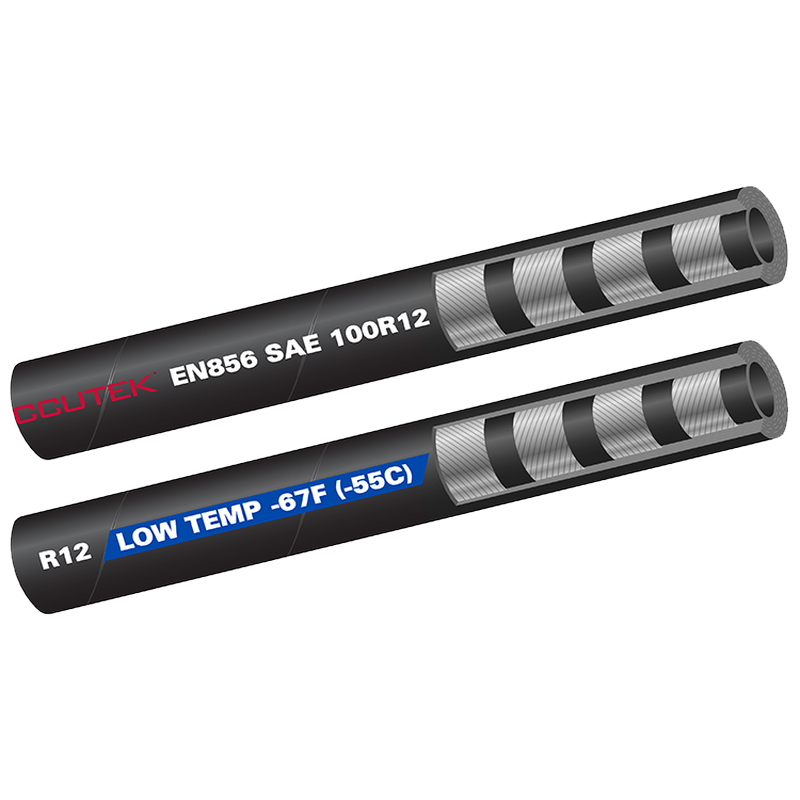
Impulse ratings measure this. In standard tests such as SAE J343 and ISO 6803, a hose is subjected to pressure pulses, typically at about 133% of its working pressure, using hot oil, and the result is the number of cycles it survives. Impulse life varies widely between hose constructions. Spiral-wire hoses typically offer far higher impulse life than braided hoses of the same size, which is why they dominate in demanding applications.
Two hoses with the same working pressure can have vastly different service lives in a pulsating system. If your equipment cycles constantly, such as excavators, loaders, presses, and log splitters, the impulse rating matters as much as the working pressure.
How these ratings affect hose selection
A reliable way to work through selection is the industry’s S.T.A.M.P.E.D checklist:
- Size: inside diameter sized for flow and velocity, plus correct length
- Temperature: fluid and ambient, including peaks
- Application: routing, flexing, abrasion, and exposure to weather or chemicals
- Material: fluid compatibility for the tube and cover
- Pressure: working pressure at or above the system maximum, including spikes
- Ends: fittings that match the hose and the ports
- Delivery: availability and lead time
On the pressure step, work in this order:
- Find the maximum system pressure, including the relief valve setting and any expected spikes.
- Choose a hose whose working pressure meets or exceeds the required level.
- Ask whether the circuit is steady or pulsing. If it pulses, compare impulse ratings and consider spiral construction.
- Check temperature limits and derating for the actual operating conditions.
- Confirm that the fittings and crimp match the hose, because an assembly is only as strong as its weakest component.
Common mistakes to avoid
- Selecting by burst pressure. It is a test result, not a working limit.
- Ignoring spikes. A circuit that averages 2,000 psi can peak well above that.
- Matching working pressure while overlooking impulse life. The hose may meet the rating and still fail early in a cycling application.
- Assuming the fitting matches the hose. Use hose ends and crimp specifications approved for the hose you are using.
- Reusing ageing hose. Heat, abrasion, and fatigue reduce the margin over time, so inspect and replace on a schedule.
A failed high-pressure hose is more than downtime. Escaping fluid can cause severe injury, which is one more reason to choose with margin rather than at the limit.
Choosing with confidence
Working pressure tells you what the hose is rated to carry; burst pressure tells you how much margin sits behind that rating; constant pressure points you towards temperature and duration; and impulse pressure tells you how long the hose will last under pressure pulses. Look at all four before you buy.
Not sure which hose or crimped hose ends are right for your application? Contact a Fairview team member with your system pressure, operating temperature, fluid, and duty cycle, and we will help you select the right hose and fittings.